Unequally Yoked: Protecting the Temple of God
October 14, 2026 | 6:07 am
In September, our Senior Pastor introduced a new theme under Covenant Establishment titled “The Temple of the Living God.” As I reflected on this theme during my personal devotions, the Lord brought fresh convictions and deeper understanding concerning several aspects of everyday Christian living.
One particular phrase stood out to me: “unequally yoked.” It is a phrase we often hear in singles’ seminars and discussions about marriage, but during this study, I discovered that its meaning extends beyond romantic relationships. The Apostle Paul, writing to the church in Corinth, addresses this subject in 2 Corinthians 6:14-16:
“Do not be unequally yoked with unbelievers. For what partnership has righteousness with lawlessness? Or what fellowship has light with darkness? What accord has Christ with Belial? Or what portion does a believer share with an unbeliever? What agreement has the temple of God with idols? For we are the temple of the living God.”
Being unequally yoked does not mean Christians should isolate themselves from unbelievers or avoid all interaction with those who do not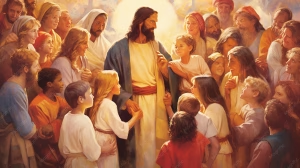 share their faith. Jesus Himself interacted with people from all walks of life. Rather, Paul warns believers against entering into close, binding relationships and partnerships that could compromise their faith, values, and devotion to God.
My study Bible highlights several examples of such associations in the Corinthian context. These included marriages between believers and unbelievers, taking disputes between Christians before unbelieving authorities, participating in practices associated with idolatry, and maintaining ties with pagan worship systems. The concern was not mere association, but influence and spiritual compromise.
Paul’s instruction is firm and emphatic. To reinforce his point, he follows it with five rhetorical questions that contrast righteousness with lawlessness, light with darkness, Christ with Belial, believers with unbelievers, and God’s temple with idols. His teaching is deeply rooted in principles already established in the Old Testament.
One such principle is found in Deuteronomy 22:10: “Do not plow with an ox and a donkey yoked together.”
At first glance, this command may seem unusual, but it paints a vivid picture. An ox and a donkey are fundamentally different animals. They differ in strength, pace, temperament, and capability. When yoked together, they cannot effectively pull in harmony because they are not designed to work as one unit.
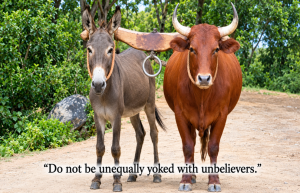 The Bible also identifies the ox and donkey differently within Israel’s ceremonial laws. While an ox met the requirements of a clean animal, a donkey did not. Together, these distinctions illustrate incompatibility. Paul borrows this imagery to teach a spiritual principle. Just as an ox and a donkey struggle to work effectively under the same yoke, believers and unbelievers operate from fundamentally different foundations, values, and worldviews. One word that captures this reality is incompatibility.
The Message Bible paraphrases Paul’s questions in a thought-provoking way:
“Is light best friends with dark? Does Christ go strolling with the Devil? Do trust and mistrust hold hands? Who would think of setting up pagan idols in God’s holy temple?”
Incompatibility in friendships, marriages, business partnerships, and other close relationships can often become a source of pain, conflict, and loss. Yet even in situations where a believer is already married to an unbeliever, Scripture provides guidance and hope. Paul writes in 1 Corinthians 7:14 that the unbelieving spouse is sanctified through the believing husband or wife, demonstrating God’s grace at work within the family.
Another lesson emerges from the image of the yoke itself: influence.
When two animals are yoked together, each affects the direction and pace of the other. If one resists, the work is hindered. If one moves in a different direction, progress becomes difficult. In much the same way, the people we closely associate with influence our decisions, priorities, beliefs, and behaviors.
This explains why Paul asks his final question: “What agreement has the temple of God with idols?” As believers, our bodies are temples of the Living God. They were created to be inhabited by His presence. The Holy Spirit dwells within us, and therefore we must carefully consider the influences we allow to shape our lives.
Is it a cultural dowry ceremony? Exercise wisdom and discernment. Is it a long-standing family tradition handed down from grandparents? Prayerfully evaluate it through the lens of Scripture. Is it a friendship that consistently gives you more reasons to doubt God than to trust Him? It may be time to reconsider its place in your life.
As I concluded my devotional time, I sensed the Holy Spirit prompting me to evaluate some of my own relationships and influences. I realized that some friendships needed boundaries or prayerful reconsideration. Some “besties,” needed to stop “bestying” because they were pulling me away from God’s purposes rather than drawing me closer to Him.
After all, what fellowship has light with darkness? I am the temple of the Living God. As I know my God, He does not share His dwelling place with darkness. There are levels in ministry, career, family, and purpose that we may never fully attain if we remain tied to relationships and influences that continuously pull us away from God’s will.
Are there unequally yoked associations in your life today?
 If the answer is yes, prayerfully bring those relationships before the Lord. Ask Him whether they are helping you become who He created you to be or whether they are limiting your spiritual growth and effectiveness for His Kingdom.
As temples of the Living God, may we have the wisdom to discern, the courage to obey, and the grace to walk in relationships that honor Christ and advance His purposes in our lives.
“For we are the temple of the living God.”
2 Corinthians 6:16
Pastor Sharon Omuloli